
In industrial communication systems, data validity is just as critical as the data itself. A subtle inconsistency in how validity is handled can lead to misleading system states, incorrect operator decisions, or downstream processing errors.
During a recent project involving SCADA protocol conversion within an industrial router, I encountered a practical example of this problem—one that highlights both the complexity of IEC 60870-5-101 and the importance of proper testing tools.
The router in question implements a protocol conversion feature, where an IEC 60870-5-101 client collects data from a remote server and maps it internally for further processing or exposure via other protocols.
At system startup, the behavior was correct:
However, an issue appeared during runtime.
If a point was removed on the IEC 101 server side after the initial interrogation:
In essence, the system had no mechanism to invalidate points that silently disappeared.
In IEC 101/104 systems, absence of data is not neutral—it is meaningful.
If a point is no longer reported:
Failing to update the validity state can result in:
To properly investigate and fix the issue, reproducibility was essential. This is where the VestaTel SCADA Multi-Protocol Simulator proved extremely effective.
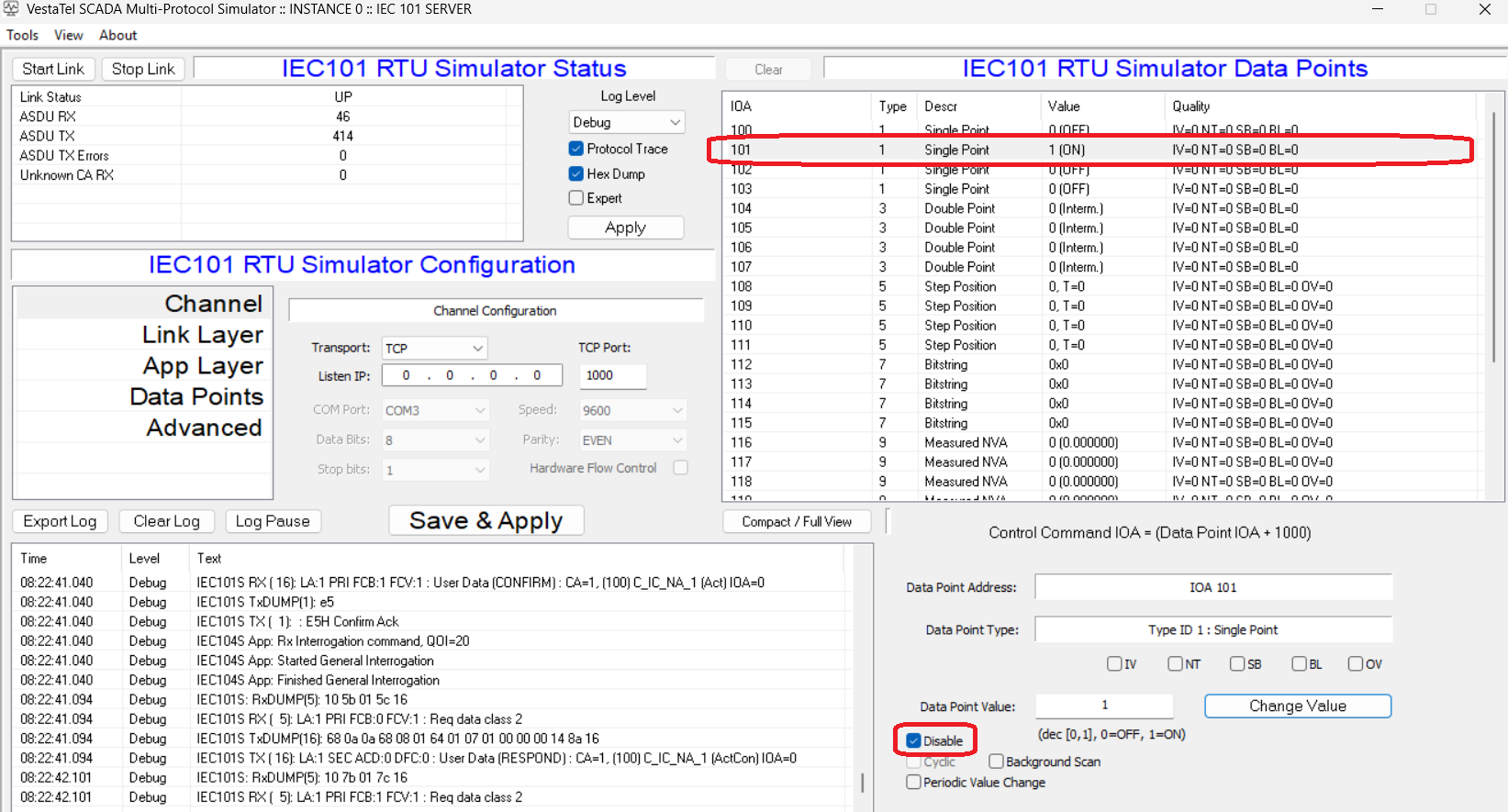
The test setup was straightforward:
One of the key advantages of the simulator is how quickly such scenarios can be reproduced—without custom scripting or complex lab setups. The ability to dynamically enable or disable individual data points makes it particularly useful for testing edge cases like this one.
After the second interrogation cycle:
This clearly demonstrated the flaw:
The client logic only updated validity on received points, but did not handle missing points.
The issue stemmed from an incomplete state management strategy:
A robust approach requires:
This ensures the internal data model reflects the true state of the upstream device.
What is not reported can be just as important as what is.
This case highlights how subtle protocol handling issues can lead to significant system inconsistencies—and how having the right testing tools makes all the difference. If you are working with IEC 101/104 or building protocol conversion solutions, tools like the VestaTel SCADA Multi-Protocol Simulator can dramatically reduce debugging time and improve reliability.